


If you want the short answer, here it is: smartwatch marketing in Bangladesh works best when you treat the sale as a conversation, not a checkout page.
Win the Messenger inbox, respect the cash-on-delivery reality, and let real reviewers do the convincing. Brands that ignore this are still shouting into a feed while their customers are quietly asking “price please?” in a DM.
Now let me tell you how we got here, because the story matters more than the bullet points.
The Market Didn’t Explode. It Grew Up.
A few years ago, many people in the gadget trade expected a big bang. They thought smartwatches would blow up like smartphones did. That did not happen.
Something more useful happened instead. The market matured. Consumers stopped grabbing anything with a screen. They started asking sharper questions.
Is this brand reliable? How is the display? What about battery life? Will it still work after three months?
That shift changes everything about how you market.
Value for money is still the loudest voice in the room. But “value” no longer means “cheapest.”
Buyers want proof that the extra taka buys something real.
The takeaway for a business owner: Stop leading with price alone. Lead with proof. Then let price feel like a fair trade.
Your Customer Lives in a Relay Race, Not a Funnel
Here is the part most marketing decks get wrong. In Bangladesh, the buying journey is not one neat pipeline. It is a relay race.
Discovery happens on Facebook. Negotiation happens in Messenger. Money changes hands at the door. And a phone call often decides whether that door opens at all.
Facebook alone reaches around 64 million people in Bangladesh. The country runs more than 500,000 business pages. A huge chunk of them act as f-commerce sellers. There is no cart in most of these transactions. Every sale is a conversation.
Cash on delivery still carries roughly 75 percent of e-commerce payment volume. That is not a side note. It is the main road.
The Trust Deficit Is Your Biggest Competitor
Bangladeshi gadget buyers are not paranoid. They have been burned.
Counterfeit products are common. Fake warranties exist. Some pages vanish after a sale. All of this has made “scam fear” a real purchase barrier. This is especially true for non-brand gadgets bought online. A shopper sees a sleek watch at a suspiciously good price. Then she thinks, “Will this even turn on next month?”
This is why winning brands do something counterintuitive. They stop trying to look big. They start trying to look honest.
One smartwatch launch case study in Bangladesh sent products to 15 micro tech influencers. The brief was simple. Drop the watch. Dunk it in water. Scratch it on camera. No scripted praise. Just a torture test. The entire first batch of 1,000 units sold out in nine days. Customer acquisition cost came in 60 percent lower than a traditional ad-led campaign.
The lesson: In a low-trust market, a third-party reviewer is gold. Someone who says “I tried to break it and here’s what happened” beats ten polished brand videos.
Reviews Are Your Real Sales Team
Bangladeshi buyers research before they spend.
Even when the research happens inside a social feed. They watch a short video. They scroll the comments. Then they open a chat to ask a question. If any step feels off, they leave.
YouTube tech reviewers have become a quiet powerhouse for smartwatch sales here. Not because people love long videos. Because a detailed review feels like evidence.
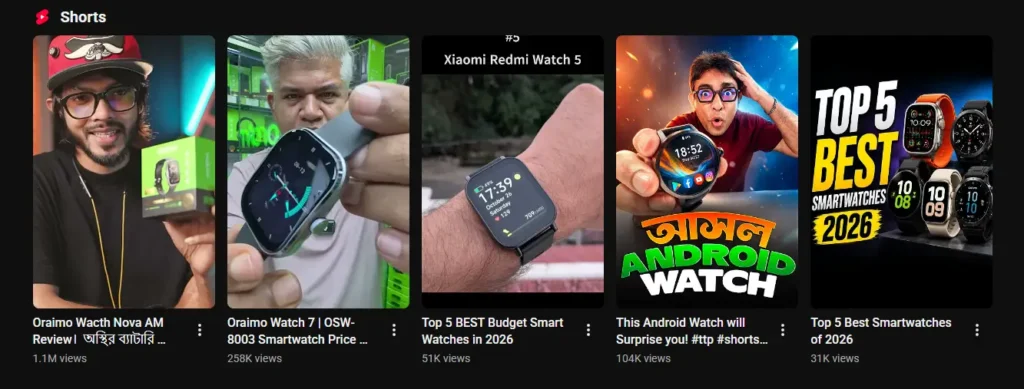
That is not just marketing. That is trust infrastructure.
Facebook Is the Stage. Messenger Is the Cash Register.
Let me paint a scene. It happens thousands of times a day in Dhaka and Chattogram.
A shopper sees a smartwatch video. She taps the page. She sends a message: “Price?” The seller replies with a voice note, not a bot. She asks about warranty. The seller sends a screenshot of the official warranty card. She says she wants one. The seller confirms the address. Then comes a bKash request or a cash-on-delivery confirmation.
The whole thing takes eleven minutes. No website visit. No abandoned cart. No credit card.
This is why Facebook Messenger is not a “support channel” in Bangladesh. It is the checkout.
Reach the right audience with a smarter digital marketing strategy built for your business.
TikTok Is for Discovery. Messenger Is for Closing.
TikTok has around 56 million adult users in Bangladesh. It has become a genuine discovery engine. But the transaction still lands in an inbox.
The smartest brands use TikTok for the “what is this?” moment. They do not use it for the “buy now” moment. A fifteen-second clip of the watch surviving a splash, a run, or a dropped water bottle does the job. Then the caption or bio points to Messenger.
This two-step is not a weakness. It matches how people actually behave. They want to be entertained first. They want to be sold to second.
Offline Still Matters More Than You Think
It is tempting to treat Bangladesh as a purely online market. The social numbers are very loud.
But smartwatch buyers still want to touch the product. They want to check the strap. They want to see the display under real light.
For a smaller brand: You do not need fifty stores. You need one credible partner. You need one visible warranty policy. You need one place where a customer can walk in and say, “Show me.”
Price Segments Are Not Just Numbers. They Are Different Stories.
The Bangladesh smartwatch price ladder is wide. Entry-level watches start around BDT 1,500 to 2,500. The calling-capable mid-range sits roughly between BDT 3,000 and 8,000. Premium and flagship models climb far higher. Apple and Samsung occupy the top.
But the marketing story changes at every rung.
At the entry level, the story is simple. “You do not have to choose between a watch and a phone.” At the mid-range, it is about capability. “You get calling, health tracking, and a screen that does not embarrass you.” At the premium level, it is about identity. “You are buying an ecosystem and a status signal.”
The mistake is using a premium brand script to sell a budget watch. The buyer hears the mismatch immediately. The value proposition has to match the price band. It should not match the brand’s ego.
What Actually Works: A No-Nonsense Playbook
Let me pull this together into something you can use this week.
First, make your inbox the center of your marketing. Every ad, every video, every post should point to a conversation. Not a cold checkout. Reply with voice notes when possible. Human voice cuts through the noise in a way that a template cannot.
Second, build a review wall before you build an ad campaign. Send samples to micro reviewers who will test the product honestly. Let them say what is bad. The honesty is the point. One Bangladesh campaign sold out its first 1,000 units in ten days purely on YouTube review traffic.
Third, price for the segment you can actually serve. If your warranty and after-sales support are thin, do not pretend to play in the premium band. If your product is solid but unknown, the mid-range with strong proof is a better home. The bottom with no trust is a trap.
Fourth, treat cash on delivery as a feature, not a flaw. Confirm every COD order with a call before dispatch. This one step reduces returns and protects your courier cost. A 2,000 Taka parcel deserves a 1.40 Taka confirmation message or a thirty-second phone call.
Fifth, let offline and online feed each other. Use a retail partner or a small experience point so buyers can see the product. Then use social proof from that offline presence in your online content. The two channels are not competitors. They are a relay team.
If the playbook feels like a lot to run alone, that is normal. Most small teams cannot staff an inbox, shoot review content, manage Meta ads, and fix a slow landing page all at once.
This is where a partner like Growth Battle fits in without the drama. They handle Meta and Google ads, SEO, and conversion-focused web design under one roof, with fast execution and reporting you can actually read. You can start with their free 30-minute consultation and see if the fit is right before spending a taka.
Reach the right audience with a smarter digital marketing strategy built for your business.
Conclusion
Here is the quiet truth about smartwatch marketing in Bangladesh. You are not selling a screen, a strap, or a step counter.
You are selling relief from the fear of a bad purchase.
The buyer wants to know three things. Will it work? Will someone answer if it does not? Is this seller real?
Every marketing choice either answers those questions or avoids them. The brands that answer them plainly will survive. They answer in the inbox. They answer on YouTube. They answer in a warranty card. They answer at the door. Those are the brands that will still be here when the market matures even further.
The smartwatch market in Bangladesh did not explode. It grew up. Your marketing should grow up with it.
